explain what has happened to each of the 6 carbons found in the original glucose molecule.
five.9: Cellular Respiration
- Page ID
- 17025

This inviting campfire tin be used for both heat and light. Rut and lite are 2 forms of energy that are released when a fuel like wood is burned. The cells of living things likewise become energy by "called-for." They "burn" glucose in the process chosen cellular respiration.
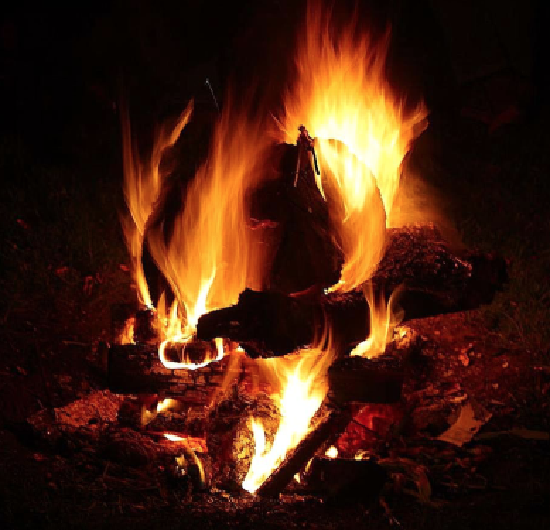
Inside every cell of all living things, energy is needed to carry out life processes. Energy is required to break down and build upwards molecules and to transport many molecules across plasma membranes. All of life'southward work needs free energy. A lot of energy is besides but lost to the environment as heat. The story of life is a story of energy flow — its capture, its change of class, its employ for work, and its loss equally estrus. Energy, unlike matter, cannot be recycled, so organisms require a constant input of energy. Life runs on chemic free energy. Where practice living organisms go this chemical energy?
Where practice organisms get energy from?
The chemical energy that organisms need comes from food. Food consists of organic molecules that store energy in their chemic bonds. Glucose is a simple carbohydrate with the chemical formula \(\mathrm{C_6H_{12}O_6}\). It stores chemic energy in a concentrated, stable form. In your torso, glucose is the form of energy that is carried in your claret and taken upwards by each of your trillions of cells. Cells exercise cellular respiration to extract energy from the bonds of glucose and other food molecules. Cells can store the extracted free energy in the form of ATP (adenosine triphosphate).
What is ATP?
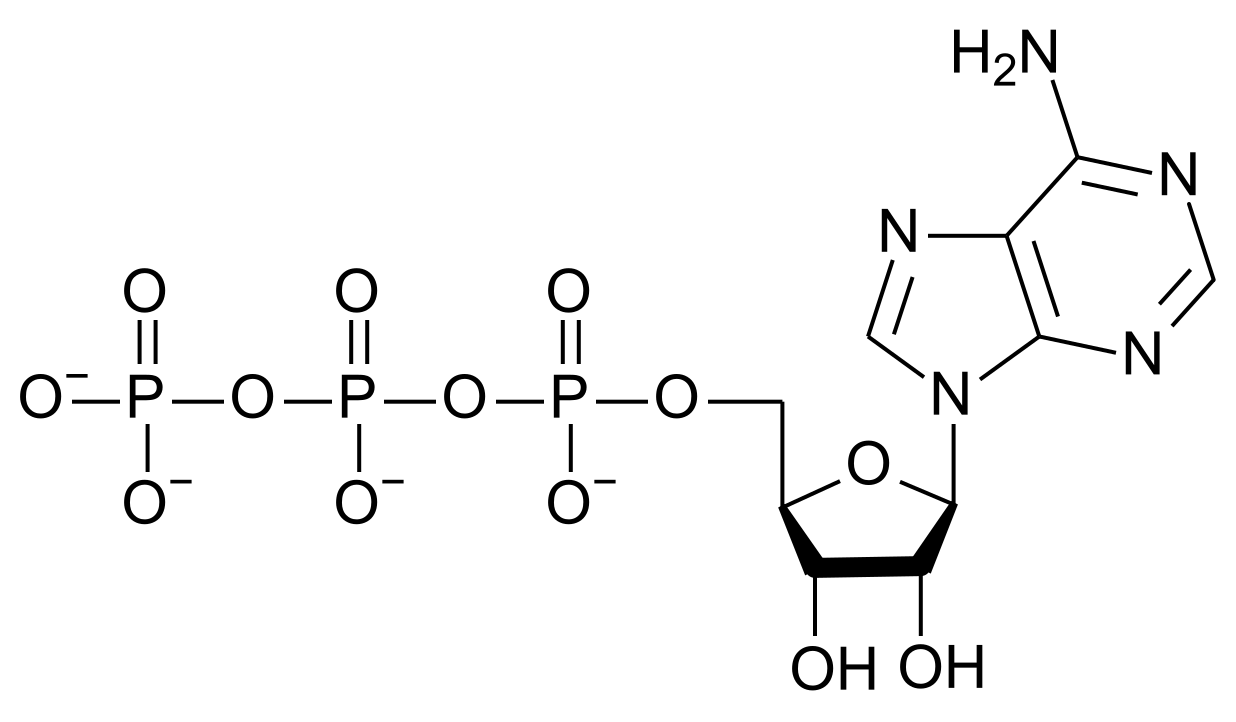
Let's accept a closer look at a molecule of ATP, shown in the figure \(\PageIndex{2}\). Although it carries less free energy than glucose, its structure is more complex. "A" in ATP refers to the majority of the molecule – adenosine – a combination of a nitrogenous base of operations and a v-carbon sugar. "T" and "P" indicate the 3 phosphates, linked by bonds that concord the energy actually used past cells. Usually, only the outermost bond breaks to release or spend free energy for cellular work.
An ATP molecule is like a rechargeable battery: its energy can exist used past the cell when it breaks apart into ADP (adenosine diphosphate) and phosphate, and and so the "worn-out battery" ADP can be recharged using new free energy to attach a new phosphate and rebuild ATP. The materials are recyclable, just remember that energy is not! ADP can be farther reduced to AMP (adenosine monophosphate and phosphate, releasing additional energy. As with ADT "recharged" to ATP, AMP can be recharged to ADP.
How much energy does it price to do your torso's work? A single cell uses nearly 10 million ATP molecules per second and recycles all of its ATP molecules well-nigh every xx-xxx seconds.
What Is Cellular Respiration?
Some organisms tin make their ain food, whereas others cannot. An autotroph is an organism that can produce its own nutrient. The Greek roots of the word autotroph mean "self" (auto) "feeder" (troph). Plants are the all-time-known autotrophs, but others be, including sure types of bacteria and algae. Oceanic algae contribute enormous quantities of nutrient and oxygen to global food chains. Plants are likewise photoautotrophs, a blazon of autotroph that uses sunlight and carbon from carbon dioxide to synthesize chemical energy in the form of carbohydrates. Heterotrophs are organisms incapable of photosynthesis that must therefore obtain energy and carbon from food past consuming other organisms. The Greek roots of the word heterotroph mean "other" (hetero) "feeder" (troph), significant that their food comes from other organisms. Even if the food organism is some other animal, this nutrient traces its origins back to autotrophs and the process of photosynthesis. Humans are heterotrophs, as are all animals. Heterotrophs depend on autotrophs, either directly or indirectly.
Cellular respiration is the process past which individual cells break down food molecules, such as glucose and release energy. The procedure is similar to burning, although information technology doesn't produce light or intense heat every bit a bivouac does. This is because cellular respiration releases the energy in glucose slowly, in many small steps. It uses the free energy that is released to course molecules of ATP, the energy-conveying molecules that cells use to ability biochemical processes. Cellular respiration involves many chemical reactions, but they tin can all be summed upwards with this chemical equation:
\[\ce{C6H12O6 + 6O2 -> 6CO2 + 6H2O + Free energy} \nonumber\]
where the free energy that is released is in chemical energy in ATP (vs. thermal free energy every bit heat). The equation above shows that glucose (\(\ce{C6H12O6}\)) and oxygen (\(\ce{O_2}\)) react to form carbon dioxide (\(\ce{CO_2}\)) and water \(\ce{H_2O}\), releasing energy in the process. Because oxygen is required for cellular respiration, it is an aerobic process.
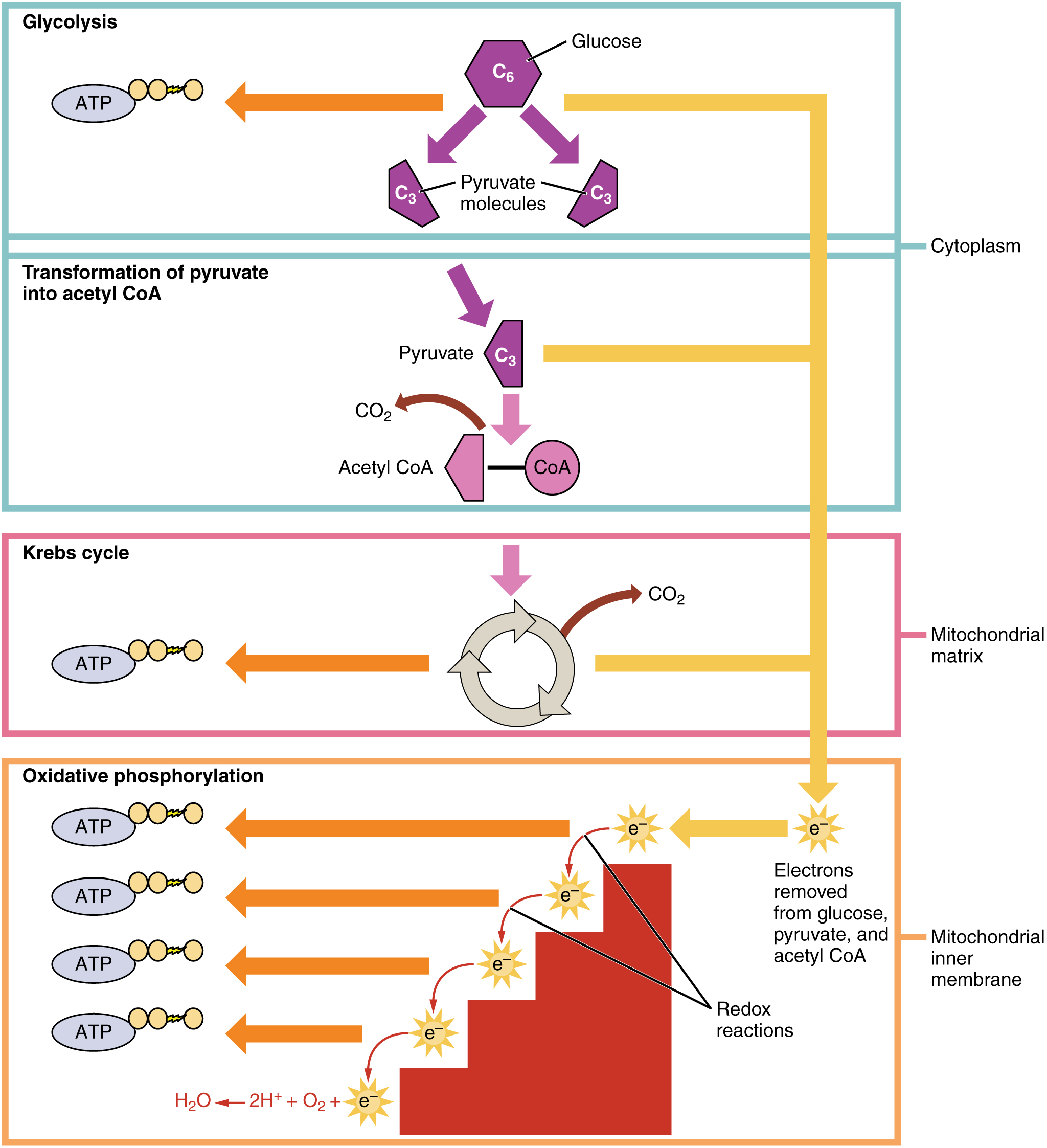
Cellular respiration occurs in the cells of all living things, both autotrophs and heterotrophs. All of them catabolize glucose to course ATP. The reactions of cellular respiration can be grouped into three master stages and an intermediate stage: glycolysis, Transformation of pyruvate, the Krebs bike (also chosen the citric acid bicycle), and Oxidative Phosphorylation. Effigy \(\PageIndex{3}\) gives an overview of these iii stages, which are also described in detail below.
Glycolysis
The first stage of cellular respiration is glycolysis. This process is shown in the meridian box in Figure \(\PageIndex{three}\) showing a 6-carbon molecule being broken down into two 3-carbon pyruvate molecules. ATP is produced in this process which takes place in the cytosol of the cytoplasm.
Splitting Glucose
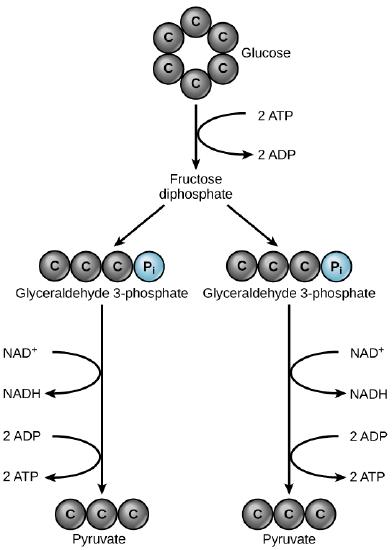
The discussion glycolysis means "glucose splitting," which is exactly what happens in this stage. Enzymes divide a molecule of glucose into two molecules of pyruvate (also known as pyruvic acid). This occurs in several steps, equally shown in figure \(\PageIndex{iv}\). Glucose is first split into glyceraldehyde iii-phosphate (a molecule containing 3 carbons and a phosphate group). This process uses 2 ATP. Next, each glyceraldehyde 3-phosphate is converted into pyruvate (a 3-carbon molecule). this produces two iv ATP and 2 NADH.
Results of Glycolysis
Free energy is needed at the start of glycolysis to split the glucose molecule into 2 pyruvate molecules. These two molecules get on to stage 2 of cellular respiration. The energy to split glucose is provided by two molecules of ATP. As glycolysis gain, energy is released, and the free energy is used to brand four molecules of ATP. As a result, there is a net gain of two ATP molecules during glycolysis. loftier-energy electrons are also transferred to energy-carrying molecules called electron carriers through the process
known as reduction. The electron carrier of glycolysis is NAD+(nicotinamide adenine diphosphate). Electrons are transferred to two NAD+ to produce two molecules of NADH. The free energy stored in NADH is used in phase Iii of cellular respiration to make more ATP. At the finish of glycolysis, the following has been produced:
• 2 molecules of NADH
• 2 net molecules of ATP
Transformation of Pyruvate into Acetyl-CoA
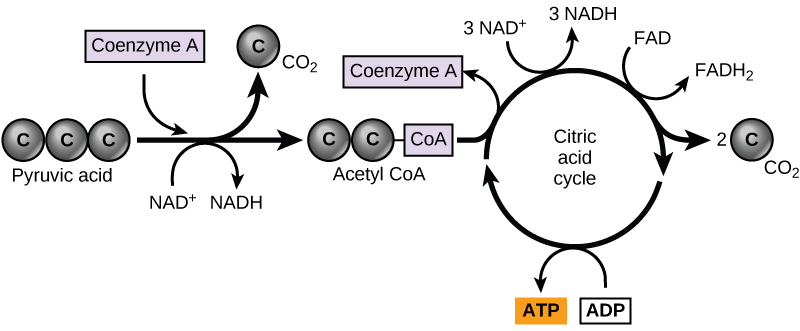
In eukaryotic cells, the pyruvate molecules produced at the end of glycolysis are transported into mitochondria, which are sites of cellular respiration. If oxygen is available, aerobic respiration will go frontwards. In mitochondria, pyruvate will be transformed into a two-carbon acetyl group (by removing a molecule of carbon dioxide) that will exist picked up by a carrier chemical compound called coenzyme A (CoA), which is made from vitamin B5. The resulting compound is called acetyl CoA and its production is frequently called the oxidation or the Transformation of Pyruvate (see Effigy \(\PageIndex{5}\). Acetyl CoA tin be used in a diversity of means by the cell, but its major function is to deliver the acetyl group derived from pyruvate to the next pathway step, the Citric Acid Bicycle.
Citric Acrid Wheel
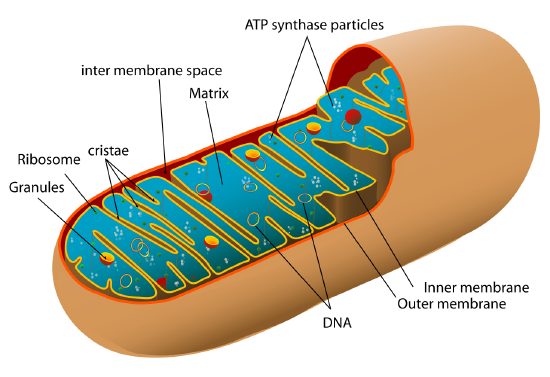
Before y'all read about the terminal two stages of cellular respiration, y'all demand to review the structure of the mitochondrion, where these two stages take place. As you can meet from Figure \(\PageIndex{6}\), a mitochondrion has an inner and outer membrane. The infinite between the inner and outer membrane is called the intermembrane infinite. The space enclosed by the inner membrane is chosen the matrix. The second stage of cellular respiration, the Krebs bike, takes identify in the matrix. The third stage, electron transport, takes place on the inner membrane.
Call back that glycolysis produces two molecules of pyruvate (pyruvic acrid). Pyruvate, which has three carbon atoms, is split apart and combined with CoA, which stands for coenzyme A. The product of this reaction is acetyl-CoA. These molecules enter the matrix of a mitochondrion, where they start the Citric Acid Cycle. The third carbon from pyruvate combines with oxygen to form carbon dioxide, which is released every bit a waste matter product. High-free energy electrons are likewise released and captured in NADH. The reactions that occur next are shown in Figure \(\PageIndex{7}\).
Steps of the Citric Acid (Krebs) Cycle
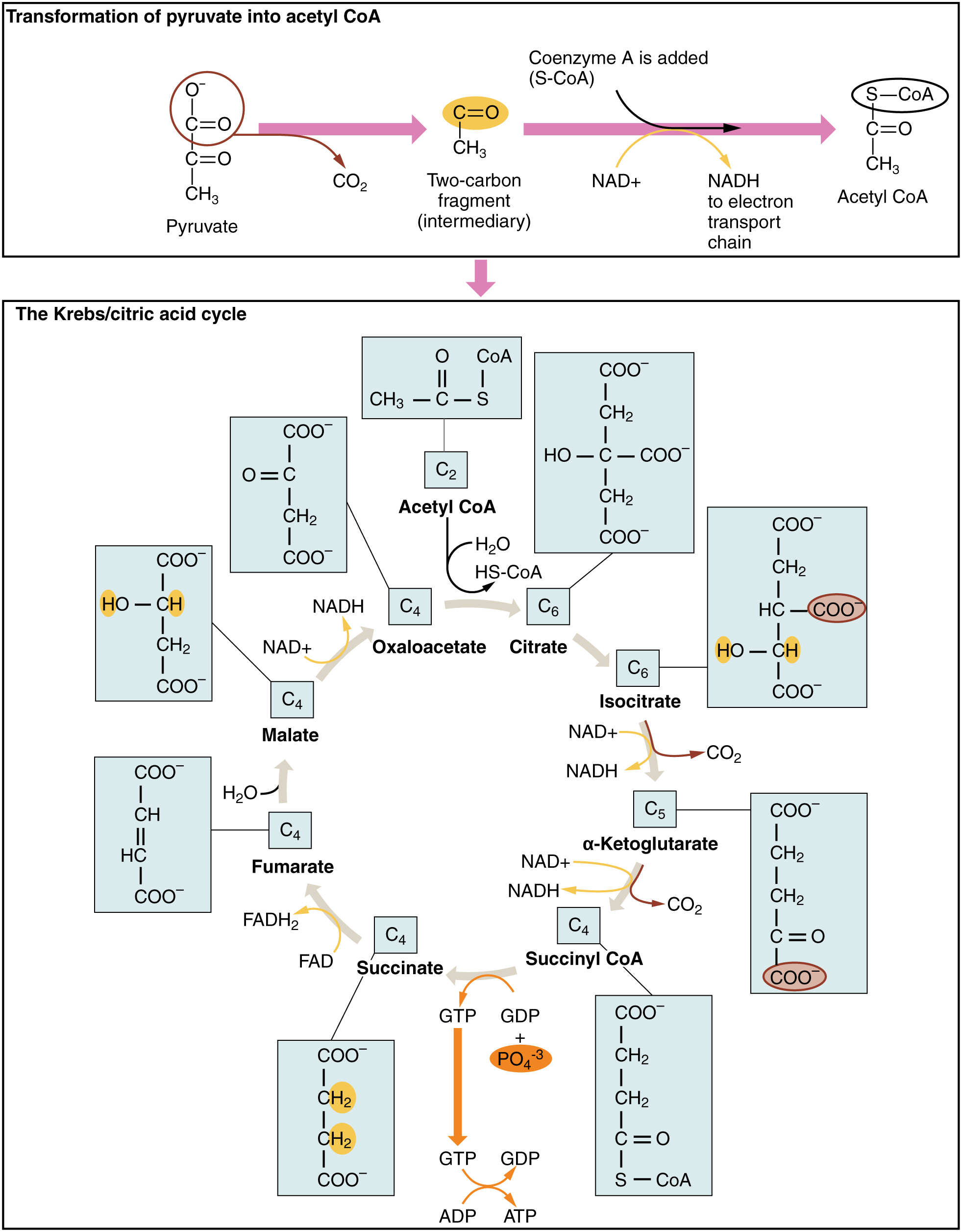
The Citric Acid Bike begins when acetyl-CoA combines with a four-carbon molecule called OAA (oxaloacetate; see the lower panel of Effigy \(\PageIndex{7}\)). This produces citric acrid, which has six carbon atoms. This is why the Krebs cycle is also called the citric acid wheel. After citric acid forms, it goes through a series of reactions that release energy. This free energy is captured in molecules of ATP and electron carriers. The Krebs cycle has ii types of energy-conveying electron carriers: NAD+ and FAD. The transfer of electrons to FAD during the Kreb'southward Bike produces a molecule of FADH2. Carbon dioxide is too released as a waste product of these reactions. The concluding step of the Krebs bicycle regenerates OAA, the molecule that began the Krebs bike. This molecule is needed for the adjacent plow through the cycle. Two turns are needed because glycolysis produces ii pyruvate molecules when it splits glucose.
Results of the Citric Acid Cycle
After the 2nd turn through the Citric Acrid Cycle, the original glucose molecule has been broken down completely. All six of its carbon atoms accept combined with oxygen to form carbon dioxide. The free energy from its chemical bonds has been stored in a full of 16 energy-carrier molecules. These molecules are:
- 2 ATP
- 8 NADH
- two FADH\(_2\)
- 6 CO\(_2\): 2 CO\(_2\) from Transformation of Acetyl CoA and four CO\(_2\) from Citric Acid Wheel.
Oxidative phosphorylation
Oxidative phosphorylation is the last stage of aerobic cellular respiration. In that location are two substages of oxidative phosphorylation, Electron transport chain and Chemiosmosis. In these stages, energy from NADH and FADH2, which result from the previous stages of cellular respiration, is used to create ATP.
Electron Ship Chain (ETC)
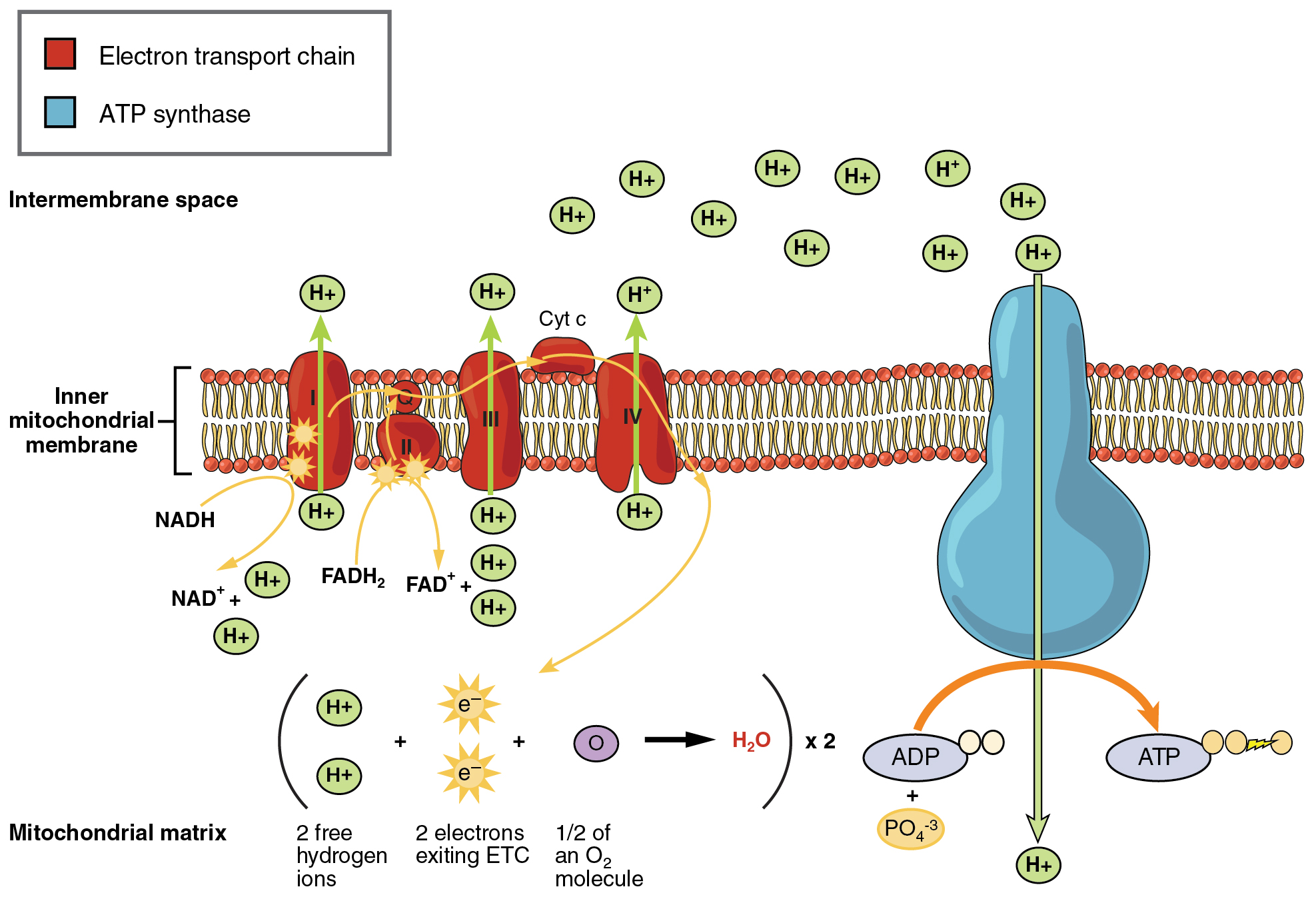
During this stage, loftier-free energy electrons are released from NADH and FADH2, and they move forth electron-transport chains establish in the inner membrane of the mitochondrion. An electron-transport chain is a series of molecules that transfer electrons from molecule to molecule by chemic reactions. These molecules are plant making up the three complexes of the electron transport chain (cerise structures in the inner membrane in Figure \(\PageIndex{8}\)). As electrons period through these molecules, some of the energy from the electrons is used to pump hydrogen ions (H+) across the inner membrane, from the matrix into the intermembrane infinite. This ion transfer creates an electrochemical slope that drives the synthesis of ATP. The electrons from the final protein of the ETC are gained past the oxygen molecule, and it is reduced to h2o in the matrix of the mitochondrion.
Chemiosmosis
The pumping of hydrogen ions beyond the inner membrane creates a greater concentration of these ions in the intermembrane space than in the matrix – producing an electrochemical gradient. This gradient causes the ions to flow back across the membrane into the matrix, where their concentration is lower. The flow of these ions occurs through a poly peptide complex, known as the ATP synthase circuitous (see blue structure in the inner membrane in Figure \(\PageIndex{8}\). The ATP synthase acts every bit a channel protein, helping the hydrogen ions beyond the membrane. The menstruum of protons through ATP synthase is considered chemiosmosis. ATP synthase also acts as an enzyme, forming ATP from ADP and inorganic phosphate. It is the flow of hydrogen ions through ATP synthase that gives the energy for ATP synthesis. Afterwards passing through the electron-transport concatenation, the depression-energy electrons combine with oxygen to course h2o.
How Much ATP?
You take seen how the 3 stages of aerobic respiration employ the free energy in glucose to make ATP. How much ATP is produced in all three stages combined? Glycolysis produces 2 ATP molecules, and the Krebs bike produces 2 more. Electron transport from the molecules of NADH and FADH2 fabricated from glycolysis, the transformation of pyruvate, and the Krebs bicycle creates equally many as 32 more ATP molecules. Therefore, a full of upward to 36 molecules of ATP can exist made from just one molecule of glucose in the process of cellular respiration.
Review
- What is the purpose of cellular respiration? Provide a concise summary of the process.
- Describe and explicate the structure of ATP (Adenosine Tri-Phosphate).
- State what happens during glycolysis.
- Describe the structure of a mitochondrion.
- Outline the steps of the Krebs cycle.
- What happens during the electron transport stage of cellular respiration?
- How many molecules of ATP tin can be produced from 1 molecule of glucose during all three stages of cellular respiration combined?
- Do plants undergo cellular respiration? Why or why not?
- Explain why the process of cellular respiration described in this department is considered aerobic.
- Proper noun iii free energy-carrying molecules involved in cellular respiration.
- Free energy is stored within chemic _________ within a glucose molecule.
- True or Imitation . During cellular respiration, NADH and ATP are used to make glucose.
- True or Simulated . ATP synthase acts as both an enzyme and a channel poly peptide.
- True or Faux . The carbons from glucose stop up in ATP molecules at the end of cellular respiration.
- Which stage of aerobic cellular respiration produces the most ATP?
Explore More
Source: https://bio.libretexts.org/Bookshelves/Human_Biology/Book:_Human_Biology_%28Wakim_and_Grewal%29/05:_Cells/5.09:_Cellular_Respiration

Post a Comment for "explain what has happened to each of the 6 carbons found in the original glucose molecule."